 To hear
Fuga 1 from Praeludium quintum by P. Carlmann Kolb, click here.
To hear
Fuga 1 from Praeludium quintum by P. Carlmann Kolb, click here.Registration: Principal 8', Octav 4' and Sub Octav 2'.
Christ Lutheran Church, York, PA
(now in the York County Heritage Trust)
1804
On April 16, 1804, Tannenberg, 76 years of age and in failing health, set out for York to wait for the wagon that had been packed with a newly constructed organ. This was to be his last organ - a one manual and pedal instrument of 13 ranks in a splendid case at a cost of £355. On May 17, toward evening, while he was standing on a bench or scaffold to tune, Tannenberg suffered a stroke and fell to the gallery floor, striking his head. He died on the morning of May 19. The funeral service was held in Christ Lutheran Church with his organ playing for the first time.
The organ remained in the Lutheran Church's old stone building of 1762, until that building was torn down and a new one built in 1811-1812. The Tannenberg organ was placed in the west gallery of the new building where it remained until 1874. In that year, the church completely rebuilt the interior of their building, adding a new floor at the level of the galleries. This was a common rearrangement process in Pennsylvania done in order to provide churches with more space. A new gallery was installed, but because of the limited height, the case of the organ was shortened. An old photograph of the organ still in the church's gallery shows it in this state. The organ builder who performed this work has remained unknown despite extensive research. It is possible that the organ had been worked on at some point by Henry F. Berger, who established an organ building shop in York in 1859. However, it could not have been Berger who altered the organ in 1874 as he had died in Ohio in 1862.
In 1893, Christ Lutheran Church purchased a new organ and the Tannenberg went unused until it was dismantled and completely rebuilt in 1905 by Reubin Midmer & Son. His alterations were extensive: an internal framework was constructed to support the chest instead of by the case itself and the bottom side panels were swung out to the front to support new zinc front pipes (see photo below). The entire winding system was discarded and a new single-rise reservoir was placed within the case. In addition, Tannenberg's pedal chest and pedal action were discarded in favor of a tubular-pneumatic chest. The keyboard and pedalboard were replaced as well. Finally, Tannenberg's Trumpete 8' was discarded and a tenor c Oboe 8'. Midmer also raised the wind pressure (necessary for the tubular-pneumatic action to work properly) and raised the cut-ups on many of the pipes. The rebuilt organ was installed in the Beehive Chapel which was used by the Sunday School of Christ Church.
In 1945, the Tannenberg was removed from the Beehive Chapel and given to the Historical Society of York County (now the York County Heritage Trust). It was not until 1958 that the organ was set up in their museum; the work being completed by Fred Furst. E. Power Biggs helped make this organ well-known through his recording The Organ in America which featured the Tannenberg organ on more than half the LP record. The sound there was magnificent as the room, which was a former car show room, was large and the floor was solid concrete. Two photos below show the organ in this position.
In 1986, the Historical Society embarked on an ambitious plan to completely renovate their facilities. As part of this work, the Tannenberg organ was to be relocated to a more prominent location within the museum. The author took over as consultant and after some discussion, the decision was made to contract with R. J. Brunner & Co. to restore the organ back to its 1804 condition. In July of 1987, the Tannenberg organ was dismantled and the work of restoration begun. Through available funds, the Brunner shop was able to completely restore the case, returning it to its original height and fabricating new upper side panels. The internal framework from 1905 was removed and the chest was made to once again be supported by the case. All the pipe work was restored as much as possible. However, lack of funds prevented the pedal chest as well as the old wind system from being replicated. Also, the Oboe 8' from 1905 remains. Since no reed stop from any Pennsylvania-German organ has survived, the replication of a Trumpet for this organ will have to be somewhat of an extrapolation. It is hoped that in the near future, the York County Heritage Trust will be able to secure the needed funds to finally return this magnificent work of David Tannenberg to its entirely original state.
The stop list at present is:
| Manual: C-f3, 54 notes | |
| Principal | 8F. |
| Gedackt | 8F. |
| Viola da Gamba | 8F. |
| Octav | 4F. |
| Flaute | 4F. |
| Quinte | 3F. |
| Sub Octav | 2F. |
| Mixtur | |
| Trumpete (old Midmer Oboe) | 8F. |
| Pedal: C-c1, 25 notes | |
| Sub Bass | 16F. |
| Octav Bass | 8F. |
| Coppel | |
The Principal 8' is in the facade from low D to middle e. The Gedackt 8' is stopped wood and the Flaute 4' is open. The third rank of the Mixtur begins at tenor f and is a Terz. (It is interesting to note that several antique organs in Thuringia had Mixtur stops with Terz ranks.) The Sub Bass is stopped and the Octav Bass is open wood. The pedal pipes are situated behind the organ in the typical arrangement for Pennsylvania-German organs. Tannenberg provided a separate pallet in the manual chest for each of the pedal notes so that the pedal Coppel engages these when drawn. Presently, these extra pallets are unused due to the 1905 tubular pneumatic arrangement. Presently, the old tenor c Midmer Oboe 8' is on the toe board where Tannenberg's reed stop was. The lower 12 notes are blocked off.
NEW INFORMATION: Recently, an old document in the archives at Christ Lutheran Church has come to light. It is a proposal for work to be done on the Tannenberg organ by an organ builder by the name of Franz Trauz. The document is dated June, 1839. Among the proposed items, Trauz mentions that he would work on the Posaun and the Vox Humana. This clearly changes the assumption that Tannenberg had provided a Trompete 8' for the manual reed. Tannenberg clearly loved color stops and perhaps felt that another color stop would have been more useful than a chorus reed. The present absence of the Posaun rank is more of a mystery but could possibly be explained by the height restriction in the gallery of Christ Lutheran Church after the interior was rebuilt in 1874. Is it possible they were discarded at this time because there was insufficient height for them? It is also possible that Midmer discarded them although we will never know for sure as Midmer replaced the Tannenberg pedal chest with his own Tubluar-pnuematic chest. To open a PDF of the German and English translation of this document, click here.
As a result of this new information, it now appears that the original stop list was this:
| Manual: C-f3, 54 notes | |
| Principal | 8F. |
| Gedackt | 8F. |
| Viola da Gamba | 8F. |
| Octav | 4F. |
| Flaute | 4F. |
| Quinte | 3F. |
| Sub Octav | 2F. |
| Mixtur | |
| Vox Humana | 8F. |
| Pedal: C-c1, 25 notes | |
| Sub Bass | 16F. |
| Octav Bass | 8F. |
| Posaun Bass | 16F. |
| Coppel | |
Music examples - played by Philip T. D. Cooper:
To hear
Fuga 1 from Praeludium quintum by P. Carlmann Kolb, click here.
Registration: Principal 8', Octav 4' and Sub Octav 2'.
To hear
Fuga 3 from Praeludium quintum by P. Carlmann Kolb, click here.
Registration: Principal 8', Octav 4', Quinte 3' and Sub Octav 2'
To hear
the Cadenza from Praeludium quintum by P. Carlmann Kolb, click here.
Registration: Principal 8', Gedackt 8', Octave 4', Quinte 3', Sub Octav
2' and Mixtur with
pedal Sub Bass 16' and Octav Bass 8' with Coppel for final chord only.
To hear
Was Gott tut, das ist wohlgetan by Johann Ludwig Krebs, click here.
Registration: Principal 8', Gedackt 8' and Flaute 4'.
Click on the thumbnails to see the larger pictures:
 |
 |
 |
 |
 |
 |
 |
 |
 |
 |
 |
 |
 |
 |
 |
 |
 |
The photos are as follows:
1. Photo taken around 1900 showing the organ still in the gallery of Christ
Lutheran Church.
2. Photo taken before 1945 showing the organ in the Beehive Chapel after Rubin
Midmer's rebuild of 1905.
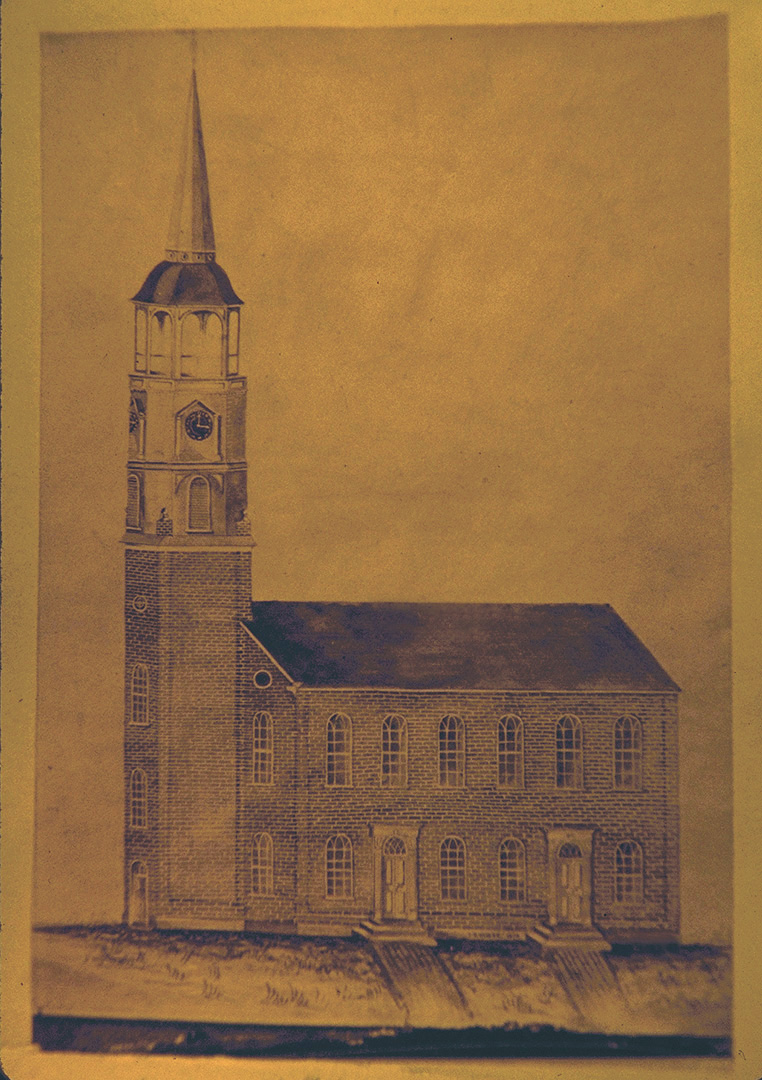
3. Photo of old engraving of the 1812 church.
4 & 5. Two photos taken in June, 1987 showing the organ before being dismantled
for restoration.
6 - 8. Photos of the organ taken shortly after the restoration of 1991.
9 - 17 Photos taken October 9, 2007 (photo #15 shows the pedal pipes in the
current situation on the 1905 Midmer chests and photos 16 & 17 are of the
steeple at Christ Lutheran Church).
The three old photos are courtesy the York County Heritage Trust, York, PA.